

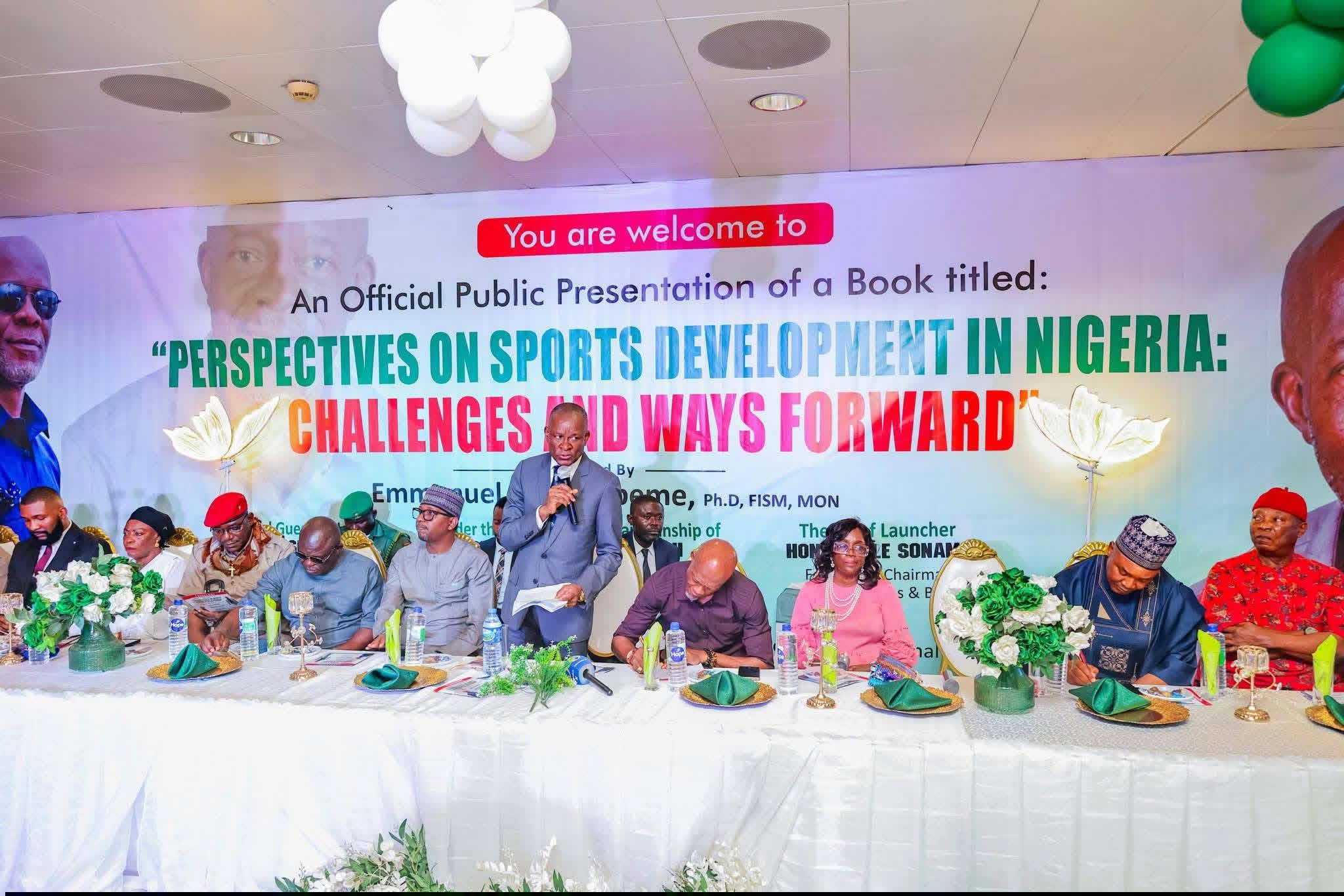
The Honourable Minister of State for Industry, Senator John Owan Enoh, on Thursday chaired the official presentation of the book Perspectives on Sports Development in Nigeria: Challenges and Way Forward, authored by sports administrator and scholar, Dr. Emmanuel Ikpeme, at the Moshood Abiola National Stadium, Abuja.
Speaking at the event, Senator Enoh reflected on his time as Minister of Sports Development, describing the period as one of the most significant and impactful phases of his public service career.
He acknowledged that the ministry faced numerous challenges during his tenure but emphasized that notable progress was made in key areas of sports administration and athlete welfare.
According to him, one of the major achievements of the administration was the successful implementation of measures that ensured athletes received their allowances and entitlements before participating in major international competitions, effectively addressing a long-standing issue that had affected the nation’s sporting ecosystem for years.
The Minister also highlighted the advancement of the Anti-Doping Bill during his stewardship, describing it as a critical reform designed to strengthen transparency, integrity, and compliance with international standards in Nigeria’s sports sector.
Commending the author, Senator Enoh described Dr. Emmanuel Ikpeme’s publication as a timely and thought-provoking contribution to national discourse on sports development.
He noted that the book provides valuable insights into the challenges confronting the sector while offering practical recommendations that can guide policymakers, administrators, researchers, and stakeholders in shaping a more sustainable future for Nigerian sports.
“The book is more than a literary accomplishment. It is a significant contribution to the conversation on the future of sports in Nigeria and the reforms needed to unlock its vast potential,” Enoh stated.
The Minister congratulated Dr. Ikpeme on the successful publication and applauded his dedication to advancing knowledge, research, and thought leadership within the sports industry.
He expressed confidence that the work would serve as an important reference resource and contribute meaningfully to efforts aimed at repositioning Nigerian sports for greater growth, competitiveness, and global relevance.
The event attracted sports administrators, policymakers, academics, athletes, and other stakeholders who gathered to celebrate the publication and engage in discussions on the future of sports development in Nigeria.