Social media has become one of the most powerful tools for political engagement in Nigeria. Citizens now have direct access to governors, ministers, commissioners, and other public officials. This has strengthened democratic participation and allowed many people to voice concerns that may never have reached the corridors of power through traditional channels.
However, with this freedom comes responsibility.
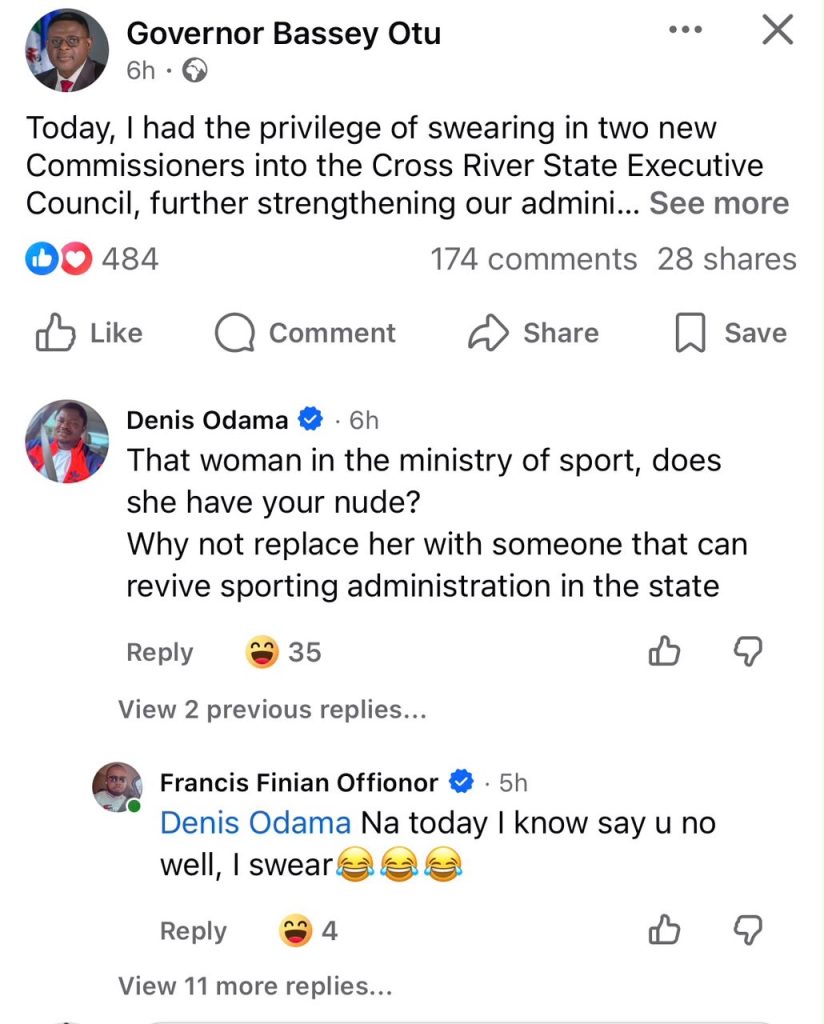
The recent Facebook comment by Odama Denis directed at the Governor of Cross River State raised an important question about the boundary between legitimate political criticism and defamatory personal insinuation. The comment did not only criticize the performance of the Ministry of Sports; it went further to suggest that the continued appointment of the Commissioner might be connected to the possession of compromising nude material.
This distinction is very important.
In a democratic society, every citizen has the constitutional right to question government decisions. It is perfectly lawful and appropriate to ask whether a commissioner is performing effectively, whether sports administration is improving, whether athletes are receiving support, and whether a replacement should be considered. These are issues of public interest.
What becomes problematic is when criticism abandons facts and performance and moves into unverified allegations that attack personal dignity and reputation.
Under Nigerian law, especially the principles of civil defamation, a statement can be defamatory if it lowers a person in the estimation of right-thinking members of society. A statement framed as a question may still be defamatory if it clearly suggests a damaging fact. Suggesting that a public official is being influenced by sexual blackmail is not the same thing as criticizing poor performance.
Beyond the legal issue, there is also a moral concern.
Public discourse should elevate society, not reduce it to mockery and humiliation. When political arguments become sexualized, they often damage not only the individuals involved but also the quality of democratic conversation. Women in public office are particularly vulnerable to this kind of insinuation, which can reinforce unfair stereotypes that their positions are based on personal relationships rather than competence.
Nigeria’s democracy needs strong criticism, investigative questioning, and fearless civic engagement. It does not need reckless allegations without evidence.
As citizens, we should learn to separate opinion from accusation.
- “The Commissioner is underperforming” is an opinion.
- “The Governor should replace her” is a political recommendation.
- “She has compromising nude material” is an allegation that demands evidence.
The future of responsible digital citizenship in Nigeria depends on our ability to criticize power without destroying reputations through speculation.
Social media should remain a platform for accountability, not a courtroom of rumours.
Democracy is strengthened when we speak boldly. It is weakened when we speak carelessly.
Denis Inakefe, ANIPR
A Public Relations Practitioner
About The Author